
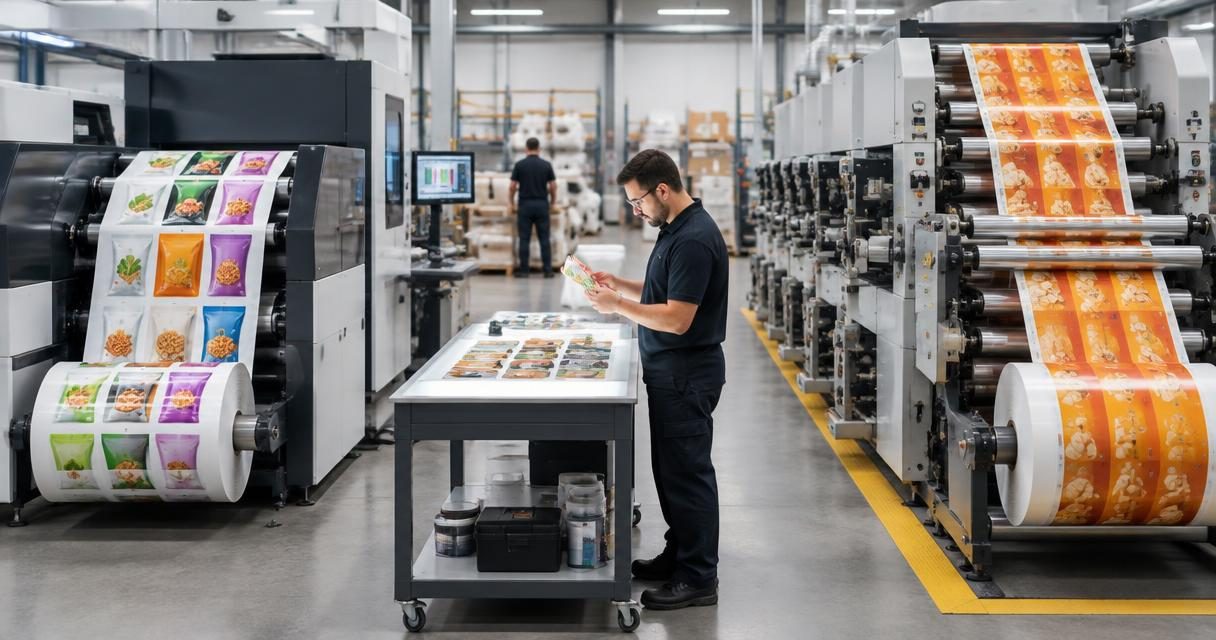
A packaging order for one stable design creates a different production problem than an equally large order divided among flavors, languages, and retailer versions. Comparing only the total quantity can point a buyer toward the wrong printing method.
A useful digital vs flexo printing comparison starts with the work the press must handle: how many designs will run, how often they change, how predictable demand is, and what color standards apply. Rotogravure belongs in that comparison when sustained volume and repeatability justify evaluating engraved-cylinder production.
The goal is not to name a universal winner. It is to select a production approach that fits purchasing, filling, inventory, and product protection requirements.
Compare the production system, not just the press
Digital, flexographic, and rotogravure printing transfer images differently. Those differences influence setup, version management, and repeat-order economics, but they do not determine every aspect of a finished package.
Digital printing produces images from digital files without conventional image-bearing plates or engraved cylinders. It can reduce the tooling burden associated with artwork changes. However, file preparation, color calibration, substrate qualification, and production scheduling still matter. Variable-data options depend on the specific platform and workflow.
Flexographic printing uses raised-image plates to transfer ink. Plate preparation and press setup create upfront work, while repeat production can benefit from retained tooling. Suitability depends on the press configuration, design, substrate, ink system, and run profile.
Rotogravure printing uses engraved cylinders to carry ink. Cylinder preparation is a significant planning consideration, making this method worth evaluating for stable, sustained programs. Its economics depend on repeat volume, tooling arrangements, and actual production conditions.
None of these methods alone determines barrier performance, seal strength, or shelf life. Those outcomes depend on the complete package structure and converting process. Use Quantum Flex Pack’s capabilities information as a starting point for questions, then confirm the specific production route proposed for your project.
Map artwork versions and order patterns
Annual volume is useful, but it is not a complete press-planning input. Break the forecast into sellable versions and expected production events.
For example, a snack brand may purchase substantial packaging volume overall while spreading demand across several flavors. If each flavor also requires separate language and promotional versions, the production schedule becomes a collection of smaller jobs. A single-design program with the same annual total may behave very differently.
Build a version matrix that records:
- Each SKU, language, retailer, and promotional variation.
- Expected order quantity and reorder frequency by version.
- Which artwork elements change and which remain fixed.
- Forecast confidence and likely revision dates.
- Minimum inventory needed to protect filling schedules.
Distinguish a repeat order from a revised order. Reprinting an approved file may reuse established settings or tooling; changing artwork can trigger new prepress, proofing, or tooling work.
Also ask whether versions can share a production campaign. Similar substrates and dimensions may help planning, but combining jobs is not automatically economical. Version quantities, finishing requirements, print layouts, and supplier workflows can limit the benefit.
Match the printing method to the production scenario
A portfolio with frequent artwork changes
Consider a food brand that regularly adjusts claims, introduces flavors, and tests regional designs. Its main risk may be obsolete printed inventory rather than press cost alone.
Digital printing is a strong candidate for evaluation because artwork changes do not require conventional plate or cylinder replacement. Buyers should still confirm proofing requirements, version-control procedures, and whether the proposed equipment supports the needed graphics and substrate.
Flexo may remain competitive where individual versions repeat reliably or where only limited tooling changes are needed. Compare the actual version schedule, not a generic description of the business as a startup or established brand.
A stable core line with predictable replenishment
Consider a household product with approved artwork, consistent demand, and recurring production releases. Flexo may offer an attractive balance when setup and tooling costs are distributed over repeated production.
Digital still deserves consideration if smaller releases meaningfully reduce inventory exposure. The comparison should include the cost of storing packaging and the operational consequences of frequent deliveries, rather than assuming either larger or smaller orders are always preferable.
A sustained program with limited design changes
For a high-volume product expected to retain the same graphics, rotogravure may warrant a quote alongside flexo. Engraved cylinders and setup can be evaluated across the expected repeat program rather than against the first shipment alone.
Do not select gravure solely because a forecast looks large. Check demand stability, cylinder ownership, storage, maintenance, replacement responsibilities, and the consequences of a design revision. A program that changes unexpectedly may lose the economic assumptions behind its original selection.
Evaluate setup and total program cost
There is no universal quantity at which digital becomes more expensive than flexo, or flexo becomes less attractive than gravure. Any crossover depends on the actual job and supplier production model.
Request comparable quotes using the same dimensions, structure, finish, artwork coverage, order schedule, and delivery requirements. Otherwise, an apparent printing advantage may actually reflect a different material specification or service scope.
Separate the commercial comparison into four groups:
- Initial costs: prepress, proofs, qualification work, plates or cylinders where applicable, and first-run setup.
- Recurring production costs: printing, materials, converting, inspection, and routine setup.
- Change costs: artwork revisions, replacement tooling, new approvals, and possible unused inventory.
- Supply costs: freight, storage, financing, emergency replenishment, and disposal of obsolete packaging.
Ask how setup material and production overruns or underruns are handled. Also clarify whether quoted tooling is owned by the buyer, reusable for future orders, or subject to storage terms.
The flexible packaging cost and pricing guide provides a useful companion topic for organizing quote discussions. Base the final choice on expected program cost and service risk, not only the quoted price per package.
Define color control before approving production
All three methods can be considered for demanding graphics, but results depend on equipment, process control, materials, and artwork preparation. Avoid assuming that one printing label guarantees superior quality.
Start with the actual visual priorities. A brand with a critical solid color may need a different evaluation than a design dominated by photography, fine type, gradients, or metallic effects. Ask how the proposed process will reproduce those elements and what limitations require artwork adjustments.
For transparent or metallized films, white ink coverage and the underlying substrate affect appearance. Surface-printed and reverse-printed structures can also present graphics differently. Review the package as a finished construction, not only as an isolated print sample.
Agree on:
- The approved color reference and measurement conditions.
- Color tolerances and the method used to assess them.
- Whether spot colors are printed directly or simulated.
- Proofing options and their relationship to production output.
- Approval responsibilities for first production and repeat orders.
If production may move between digital, flexo, and gravure, request a cross-process color review. Identical artwork files do not guarantee identical results. Build realistic expectations around agreed tolerances rather than an undefined request for a perfect match.
Plan converting, inventory, and replenishment
Press time is only one part of the schedule. Substrate availability, proof approval, tooling, drying or curing where applicable, lamination, slitting, pouch making, and release testing can affect delivery.
Digital printing may remove conventional plate-making from the workflow, but that does not make the entire packaging order immediate. Ask for a schedule that identifies the actual constraints and the point after which artwork changes affect delivery.
Operations teams should review the physical specification independently of the print method. Roll stock may require defined web width, repeat length, winding direction, core size, maximum roll diameter, and registration marks. Premade pouches need agreed dimensions, seal areas, opening features, and filling compatibility. The stand-up pouch manufacturing specifications guide is a relevant reference when building that checklist.
Smaller releases can reduce inventory exposure, but more frequent deliveries also increase dependence on replenishment reliability. Larger campaigns may reduce repeated setup while tying up storage and increasing revision risk.
Model both approaches against the filling calendar. Include realistic approval time, receiving checks, and safety stock based on service needs—not simply the shortest advertised production interval.
Use a structured decision checklist
Bring purchasing, operations, marketing, and quality into the same review. Each team sees a different failure mode: excess inventory, filling downtime, incorrect artwork, or a package that misses its performance requirements.
Before requesting a recommendation, confirm:
- Demand: Are quantities defined by version and release, not just annual total?
- Change frequency: How likely are regulatory, promotional, or design revisions?
- Graphics: Which colors and design elements are critical to acceptance?
- Materials: Is the proposed structure defined well enough for comparable quotes?
- Equipment: Are filling and converting requirements documented?
- Economics: Are setup, tooling, storage, freight, and obsolescence included?
- Planning: Which stages constrain lead time, and who approves each milestone?
- Continuity: What happens if demand rises, artwork changes, or the preferred route becomes unavailable?
Then ask each supplier to explain why its proposed process fits those inputs. A useful proposal should identify assumptions and tradeoffs rather than promise that one method is best for every order.
For additional supplier-screening questions, consult the guide to choosing a digital packaging printing company. Apply the same discipline to flexo and gravure proposals, especially around approvals, communication, and repeat-order controls.
Validate the specification before committing
Treat the initial process recommendation as a working hypothesis. Move from artwork and material review to appropriate proofs, representative samples, and a planned trial. Define acceptance criteria before production so that visual approval does not substitute for functional approval.
The validation plan should address the product’s sensitivity to oxygen, moisture, light, or aroma loss where relevant. It should also assess seals, package integrity, filling performance, handling, and expected distribution conditions. For food or other regulated applications, confirm applicable material suitability and documentation requirements with qualified parties.
Final structures and operating settings require product, equipment, distribution, and shelf-life validation. Sealing temperature, dwell time, pressure, and line speed cannot be selected reliably from the printing method alone. Changes to films, inks, adhesives, or converting conditions may require review and additional testing.
Keep the approved specification, artwork revision, color standard, and trial results together. This gives repeat orders a clear reference and makes future changes easier to evaluate.
Bring your version matrix, demand profile, package requirements, and current production challenges to discuss your project with Quantum Flex Pack.
Related reading: how to review and approve packaging color proofs and preparing print-ready flexible packaging artwork.