
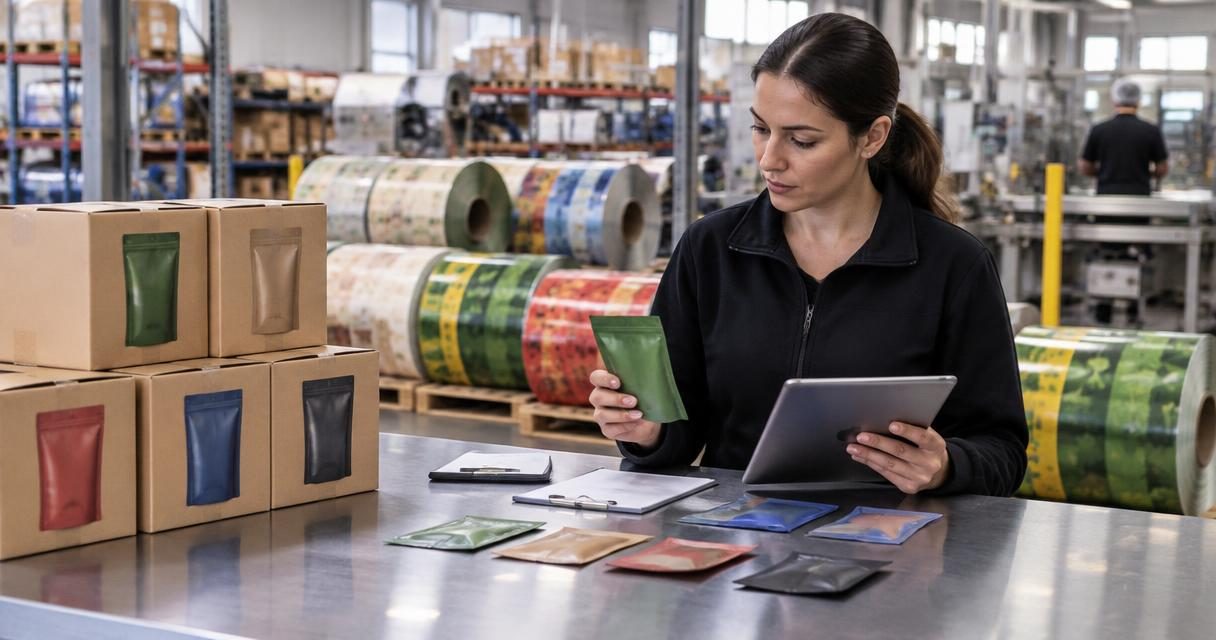
A lower price per pouch can create a more expensive inventory problem. If meeting a packaging MOQ means buying beyond realistic demand, the apparent savings may be offset by storage, financing, damaged stock, or packaging that becomes unusable after an artwork change.
The useful question is not simply, “Can the minimum be lower?” It is, “What creates this minimum, and who carries the cost and risk?” That distinction helps purchasing, finance, and operations compare quotes without confusing manufacturing efficiency with business value.
What Packaging MOQ Actually Measures
A packaging MOQ is the smallest order a supplier will accept under specified conditions. Those conditions matter as much as the quantity. A minimum may apply to an entire order, one structure, one pouch size, one printed design, or a single production run.
For roll stock, the commercial unit might be weight, length, rolls, or impressions. For premade pouches, it is often a piece count. Neither format tells you automatically how much usable production the order supports.
Ask the supplier to define:
- The unit used to state the minimum.
- Whether it applies per order, SKU, design, size, or material structure.
- Any permitted production overrun or underrun and how it is billed.
- Whether scheduled releases change delivery timing only or also change ownership and payment.
A blanket order with staged shipments is not necessarily a smaller commitment. You may still own, owe payment for, or be responsible for the full quantity. Confirm those terms before treating delayed delivery as reduced inventory exposure.
Why Production Creates Minimums
Minimums often reflect several linked production constraints rather than one arbitrary sales rule. Reducing one constraint does not necessarily remove the others.
Film procurement and structure
Film suppliers may have minimum purchase requirements tied to resin, coating, thickness, web width, or a particular construction. A converter buying a specialized barrier film may face a different procurement commitment than one using a regularly purchased material.
A custom width can also affect trim utilization. Combining demand around a common structure may help, but only when product protection, dimensions, processing, and regulatory requirements remain suitable. Never substitute a film solely to reach a lower minimum.
Printing setup and tooling
Press preparation, registration, color adjustment, and startup material create costs before saleable output begins. Flexographic work may require plates, while gravure work may require engraved cylinders. These are different tooling systems; neither should be assumed to apply to every process.
Digital printing generally avoids conventional image plates or cylinders, but it still involves file preparation, press setup, materials, and downstream work. The guide to digital flexible packaging printing for short runs provides related context; the key MOQ question is which constraints remain after the printing method changes.
Converting and finishing
Lamination, curing where required, slitting, and pouch making each introduce scheduling and setup considerations. Zippers, spouts, or other features may add component requirements and changeovers.
Ask whether the quoted minimum is driven by raw materials, printing, converting, components, or the economics of the combined job. The answer identifies which specification changes might actually help.
How SKUs Change the Order Math
An order total can hide a difficult SKU allocation. Several designs may share the same dimensions and film structure, yet each design may still carry its own artwork, scheduling, inspection, or printing requirements.
Conversely, a shared production plan may sometimes accommodate multiple designs. Whether that reduces a per-SKU minimum depends on the process and supplier—not simply on the number of pieces ordered across the account.
Consider a snack brand with one fast-selling flavor and two seasonal flavors. Splitting packaging evenly might simplify purchasing, but it could leave the core flavor short while seasonal inventory sits unused. Allocate quantities against expected consumption and uncertainty, not an equal-share rule.
Before approving a mixed-SKU order, confirm:
- Which designs can share the quoted production arrangement.
- Whether quantities can vary by design.
- Whether changing one design affects the others’ schedule or cost.
- How overruns and underruns are allocated among SKUs.
- Whether obsolete artwork strands only one SKU or a broader material commitment.
Common specifications create options, not guarantees. Use the stand-up pouch manufacturing specifications guide to organize the dimensions and construction details that need comparison.
Compare Total Exposure Not Just Unit Cost
A unit price describes the packaging purchase, not the complete financial outcome. A more useful comparison includes the cost of obtaining, holding, and potentially disposing of the inventory.
Use a consistent planning model:
Total expected order cost = packaging purchase + separately billed setup or tooling + freight and handling + carrying cost + expected obsolescence and disposal cost.
Count each item only once. For example, tooling already included in the quoted price should not be added again. Label uncertain estimates rather than presenting them as known costs.
Carrying cost can include financing or the opportunity cost of cash, storage, insurance, and inventory administration. Use your finance team’s assumptions and actual expected holding period. An annual carrying-rate estimate should not be applied unchanged to inventory expected to turn much sooner.
For the buyer’s decision, compare expected cost against the packaging you realistically expect to use. Ordered units, accepted units, and units consumed before an artwork change are not necessarily the same denominator.
The flexible packaging cost and pricing guide addresses broader price drivers. MOQ analysis adds a different question: does the quantity behind the quote fit your consumption and risk profile?
Map Cash Flow Before Approving Quantity
Packaging can require cash well before finished goods generate revenue. Deposits, tooling payments, balances due before shipment, freight, and warehousing may arrive at different points in the cycle.
Build a simple timeline from purchase commitment through packaging receipt, filling, finished-goods shipment, and customer payment. Include the time packaging waits for ingredients, production capacity, or a launch date.
For example, a beverage powder company may have enough packaging for a planned promotion but lack a confirmed filling slot. Buying the entire packaging requirement early can tie up cash without moving the product’s revenue date forward.
Separate three questions:
- Commitment: When does the purchase become noncancelable?
- Payment: When does cash leave the business?
- Consumption: When will each SKU actually use the packaging?
Scheduled releases can reduce on-site storage, but payment obligations and ownership may remain unchanged. Ask about storage charges, release deadlines, damage responsibility, and treatment of leftover stock. The buy-to-demand information is a starting point for discussing ordering approaches, not a substitute for written commercial terms.
Treat Waste as More Than Scrap
Manufacturing scrap and unused finished packaging are different waste streams. An efficient production run may reduce setup waste per saleable unit while still producing more packaging than the buyer can use.
On the other hand, repeatedly ordering very small batches may increase changeovers, startup losses, and shipment frequency. Neither “smaller is always greener” nor “larger is always more efficient” is a reliable conclusion without evidence.
Track at least three categories:
- Production losses: Startup web, trim, and rejected converted material.
- Operational losses: Packaging damaged in storage or rejected during filling and sealing.
- Obsolescence: Usable packaging retired because of graphics, claims, ingredients, formats, or demand changes.
A seasonal design illustrates the tradeoff. A longer run may offer attractive manufacturing economics, but its remaining inventory can lose commercial usefulness when the promotion ends.
Do not infer a lower environmental impact from MOQ alone. Material composition, production losses, transport, actual usage, and product protection all matter. Packaging that fails to protect the product can create losses beyond the packaging itself.
Match the Order to Real Demand
Translate every proposed quantity into coverage by SKU: how long will that inventory last under a reasonable consumption forecast? Then test the forecast against a slower-sales scenario and a delayed launch.
Use consumption rather than shipments when the two differ. Packaging delivered to a warehouse has not yet supported a sale, and finished-goods production may not follow a smooth monthly pattern.
Review these decision points:
- Is the design stable, or is a label or regulatory review pending?
- Does demand depend on a promotion, retail placement, or uncertain customer order?
- Can existing inventory cover the replenishment lead time?
- Would a common size or structure reduce fragmentation without compromising performance?
- Is the cost of running short greater than the likely excess-inventory cost?
For a stable core product, a larger commitment may be reasonable. For a design facing an upcoming ingredient declaration change, the same coverage period may be unacceptable. There is no universally correct number of months to hold; demand variability, supply reliability, storage conditions, and change risk determine the answer.
Build a Quote Review Checklist
Send suppliers a common brief so competing quotes address the same requirements. Otherwise, an apparently better MOQ may reflect a different structure, delivery scope, or allocation rule.
Include product characteristics, package dimensions, fill weight, required protection, artwork count, expected consumption by SKU, filling equipment, distribution conditions, and target shelf life. Flag unknowns instead of supplying guesses that could become production assumptions.
Before issuing a purchase order, obtain written answers to these questions:
- What specifically drives the minimum?
- What is the minimum for each SKU and for the total order?
- Which charges are one-time, recurring, or included in the unit price?
- What happens to unused purchased film or components?
- Who owns tooling, and what storage or replacement terms apply?
- What quantity variation is permitted, and how is it billed?
- What are the payment, cancellation, storage, and release terms?
- Which specification or scheduling changes could reduce the commitment?
Evaluate any proposed change across departments. Purchasing may favor the price, operations may need a different roll configuration, and finance may reject the cash timing. A shared decision prevents a local saving from becoming a larger business cost.
Validate Before You Commit
Commercially attractive packaging still has to work. Final structures and equipment settings require validation for the product, equipment, distribution conditions, and intended shelf life. A previous application or sample appearance does not establish suitability for a new use.
For roll stock, assess tracking, tension, registration, cutting, and seal performance on the intended line. For premade pouches, assess feeding, opening, filling, and sealing. Depending on the application, evaluation may also need to address contamination in the seal area, transport damage, barrier performance, and storage conditions.
Agree on acceptance criteria before the production commitment becomes difficult to change. Clarify what a trial demonstrates and what still requires longer-term testing, especially shelf-life performance. Retain the approved specification and artwork version with the purchase record.
The best packaging MOQ is a validated commitment your operation can consume—not automatically the smallest order or the lowest unit price. To review your specifications, SKU mix, demand assumptions, and ordering constraints, discuss your packaging project with Quantum Flex Pack.