
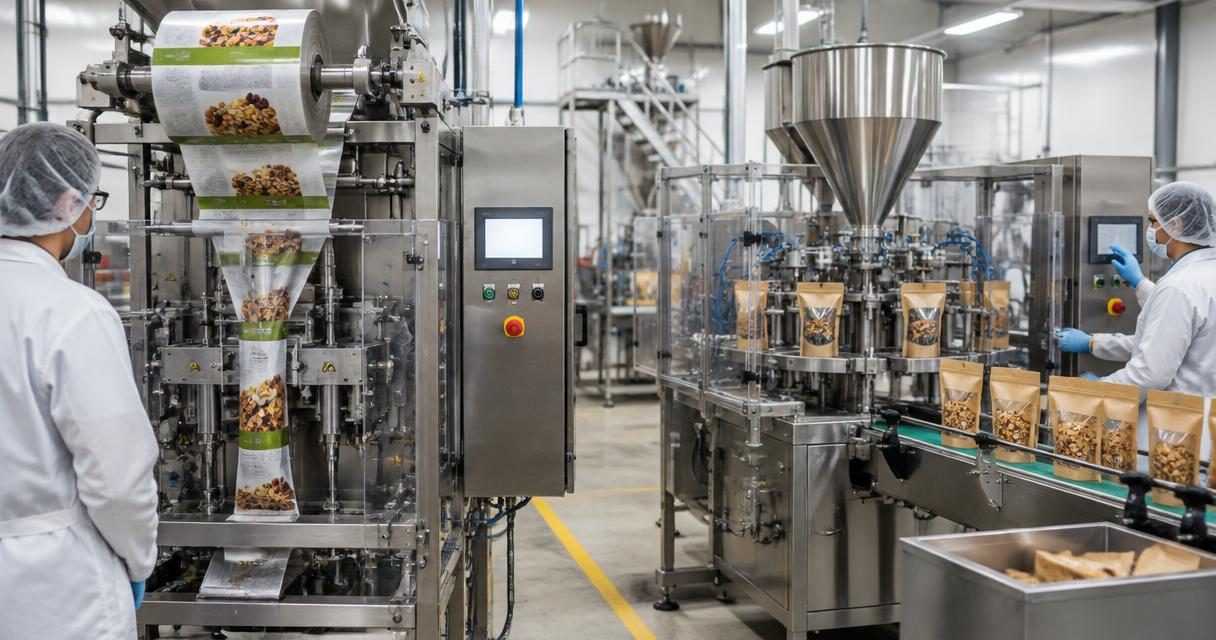
Choose the packaging process before you commit to the package. A pouch that looks right on a shelf can still be wrong for your filler, staffing model, available floor space, or production schedule. Conversely, a lower material cost may not help if reaching it requires equipment your business is not ready to operate.
For operations teams, the rollstock vs pre-made pouches decision is about where package formation happens and which responsibilities your line takes on. Rollstock brings forming into the packaging process. Pre-made pouches arrive formed, but still require reliable feeding, opening, filling, and final sealing. Compare both approaches using your actual products and production plan—not just machine brochure speeds.
Start With the Equipment You Can Actually Run
Rollstock typically runs on form-fill-seal equipment. Vertical form-fill-seal, or VFFS, feeds film around a forming system, creates a longitudinal seal, fills the package, and makes cross seals. It is commonly evaluated for products that can be dosed into a vertically formed package, such as grains, powders, and snacks.
Horizontal form-fill-seal, or HFFS, covers several machine configurations. Roll-fed horizontal pouch systems form packages before filling and sealing; horizontal flow wrappers typically wrap individual products or grouped items. These are not interchangeable applications. Confirm the specific machine architecture rather than relying on the HFFS label alone.
Pre-made pouch equipment generally takes individual pouches from a magazine or feeder, opens them, fills them, and seals the remaining opening. Zippers, gussets, spouts, and unusual shapes may require dedicated handling or tooling. A machine advertised for pouches is not automatically compatible with every pouch style.
Establish the baseline
Before requesting quotes, document:
- Machine manufacturer, model, and installed options.
- Accepted web widths or pouch dimensions, including usable filling openings.
- Filler type and product behavior, including dust, stickiness, and fragility.
- Required closures, coding, inspection, and downstream handling.
- Available utilities and current operating constraints.
Use the stand-up pouch manufacturing specifications guide to help organize dimensional questions, then confirm acceptance with the equipment supplier.
Use an Operations Decision Matrix
Build the comparison around constraints that could stop production. Mark each item as acceptable, conditional, or unresolved. Do not average away a critical incompatibility with several attractive secondary benefits.
| Decision factor | Rollstock and form-fill-seal | Pre-made pouch fill and seal |
|---|---|---|
| Existing equipment | Strong candidate when an installed line can form the required package | Strong candidate when installed equipment handles the pouch and closure |
| Capital readiness | Evaluate forming hardware, web handling, controls, and integration | Evaluate pouch feeding, opening, handling, and sealing integration |
| Operator workload | Includes roll changes, web tracking, forming, and seal monitoring | Includes pouch replenishment, pickup reliability, opening, and seal monitoring |
| Throughput limits | May be constrained by forming, dosing, seal dwell, or downstream equipment | May be constrained by feeding, opening, dosing, seal dwell, or downstream equipment |
| SKU changes | May require film, forming components, recipe, and print registration changes | May require magazine, gripper, opening, recipe, and tooling adjustments |
| Package complexity | Depends on what the forming system can produce | Depends on what the handling system can accept |
| Footprint | Include roll handling, maintenance access, and discharge equipment | Include pouch staging, loading access, and discharge equipment |
| Maintenance skills | Web transport, forming, sealing, and motion systems matter | Feeding, vacuum, grippers, sealing, and motion systems matter |
Neither column is universally cheaper, faster, or easier. Score the matrix against your equipment configuration and package requirements. An existing, well-supported line may outweigh theoretical savings from switching formats.
Compare Total Line Economics
Separate the cost of buying packaging from the cost of producing a saleable unit. Rollstock can offer material-cost advantages in some applications, but it shifts package formation onto your line. Pre-made pouches include off-line converting work, yet their economics still depend on filling efficiency and operating conditions.
A useful comparison is:
Cost per saleable unit = total comparable production costs ÷ accepted finished units.
Include packaging material, direct labor, startup waste, rejected product, maintenance, utilities, and allocated equipment costs. Apply the same accounting assumptions to both options. Also consider storage, financing, and obsolete printed inventory rather than treating them as invisible expenses.
Check capital readiness separately
A favorable unit-cost projection does not establish that a project is affordable. Ask whether the business can support equipment deposits, installation, utilities, training, spare parts, and the ramp-up period before normal output is achieved.
For example, a growing seasoning brand may project lower packaging costs on VFFS. If its budget excludes dust control and filler integration, however, that projection is incomplete. A co-packer or another filling approach may be a more practical interim path.
The flexible packaging cost and pricing guide can support the purchasing discussion, but build the investment case around your own line data and supplier quotations.
Measure Saleable Throughput and Labor
Compare accepted packages per scheduled production hour, not maximum cycles per minute. The meaningful number includes routine stops, replenishment, adjustments, checks, and rejects under representative conditions.
Request trials with the actual product whenever possible. A free-flowing granule and a dusty powder can behave very differently on the same filler. Sticky pieces may bridge in a hopper. Product in the seal area may create defects even when the machine reaches its target cycle rate.
Track these items during each trial:
- Accepted packages and rejected packages, with rejection reasons.
- Time lost to film or pouch replenishment.
- Feeding, opening, tracking, and registration interruptions.
- Fill-weight variation and product damage.
- Seal performance under the agreed test method.
- Operators required across the entire line.
Count people loading product, inspecting output, packing cases, and moving materials—not only the person at the machine controls. Automated pouch filling is not necessarily low-labor if frequent replenishment or manual downstream work remains.
Likewise, fast form-fill-seal equipment may not increase total output when the filler or case-packing station sets the pace. Map the bottleneck first, then decide whether a format change would actually relieve it.
Test Changeovers Against Your SKU Mix
A long campaign with one package size creates a different business case from a schedule with frequent size, flavor, and artwork changes. Evaluate the production sequence you expect to run, including small replenishment orders.
Time changeovers from the last acceptable unit of one SKU to the first acceptable unit of the next. Include cleaning, material removal, adjustments, verification, startup scrap, and quality release. Record hands-on labor separately from elapsed downtime.
An artwork-only change may be relatively straightforward when dimensions and material behavior stay consistent. A package-width change may require forming components on a rollstock line or handling adjustments on a pre-made pouch line. Allergen cleaning can dominate either process.
Use this decision checklist:
- Which SKUs share dimensions and equipment settings?
- Which changes require tools, parts, or maintenance support?
- Can operators retrieve and verify saved recipes?
- How much material is consumed before acceptable output resumes?
- Can the schedule group compatible runs without creating excess inventory?
Review the buy-to-demand approach alongside these scheduling questions. Purchasing cadence and production efficiency should be evaluated together, not optimized independently.
Match Controls and Floor Space to the Process
Controls should make the approved process repeatable and deviations visible. Depending on the application, useful functions may include recipe management, seal-temperature monitoring, print registration, pouch-presence detection, missing-product detection, coding verification, and reject confirmation. Confirm what is included, optional, or unavailable on the proposed machine.
Stored settings are a starting point, not proof of package integrity. Operators still need documented checks, defined adjustment limits, and escalation procedures. Material lots, ambient conditions, product temperature, and contamination can affect performance.
For rollstock, assess web tension, tracking, unwind access, and safe roll handling. For pre-made pouches, assess pickup consistency, opening verification, magazine access, and how flexible or irregular pouches move through the machine.
Draw the working footprint
Do not compare equipment dimensions alone. Put the following on a scaled floor plan:
- Product supply, filler, and any dust or spill management.
- Material staging and replenishment routes.
- Guarding, maintenance clearances, and sanitation access.
- Inspection, accumulation, case packing, and finished-goods movement.
- Electrical, compressed-air, vacuum, and other utility connections.
Have plant personnel review the layout for safety, hygiene, and workflow. A compact machine can still create an impractical line if replenishment traffic crosses finished-product handling or maintenance access is blocked.
Plan Startup and Scale Transitions
Early production often prioritizes manageable cash exposure and flexibility. That may favor a co-packer, a smaller filling setup, or pre-made pouches—but none is automatically the best startup choice. A suitable co-packer with rollstock equipment may avoid the need to purchase a line at all.
At higher demand, stable package dimensions and longer runs may justify examining dedicated form-fill-seal equipment. Use demonstrated order patterns and operating assumptions rather than treating forecast growth as guaranteed utilization.
Consider a snack business moving from contract filling toward internal production. Before changing formats, it should determine whether the proposed package protects fragile product, whether the filler maintains target weights, and whether distribution testing supports the new structure. Printing the same artwork on a different package does not make the transition technically equivalent.
Create transition gates: representative samples approved, equipment trial completed, quality criteria met, staff trained, and supply continuity arranged. Maintain a fallback plan during ramp-up. Review Quantum Flex Pack's published capabilities as background for a discussion of the requirements you need confirmed.
Ask Co-Packers for Line-Specific Answers
A co-packer's preferred format may reflect its installed equipment rather than a universal advantage. Ask for answers tied to the line that would run your product:
- What exact machine and filler will be used?
- Which dimensions, structures, and closures are accepted?
- Who approves material machinability and seal performance?
- What trial is required before commercial production?
- How are setup time, scrap, downtime, and rejected product handled commercially?
- What restrictions apply to cleaning, allergens, coding, and inspection?
- Can the same package run on a backup line?
- Who owns the specifications, settings, and trial records?
Clarify responsibility for purchasing materials and approving substitutions. A structure accepted on one line should not be assumed suitable for another without review. Document those responsibilities before ordering production packaging.
Build a Validation-Based Decision
Make the final recommendation in three parts: the preferred format, the evidence supporting it, and the conditions still requiring confirmation. This keeps a promising concept from becoming an unqualified production commitment.
Your release checklist should cover product compatibility, filling accuracy, seal integrity, package dimensions, coding, line performance, and expected handling. Define test methods and acceptance criteria with the relevant technical teams. Evaluate distribution hazards and establish shelf-life requirements appropriate to the product; an equipment trial alone cannot establish shelf life.
Final material structures and machine settings require product, equipment, distribution, and shelf-life validation. There is no universal laminate, sealing temperature, dwell time, or machine speed that can be responsibly specified from the format name alone.
Bring your equipment details, product characteristics, SKU list, demand pattern, and distribution requirements to the next conversation. To evaluate packaging options against those operating needs, discuss your project with Quantum Flex Pack.