
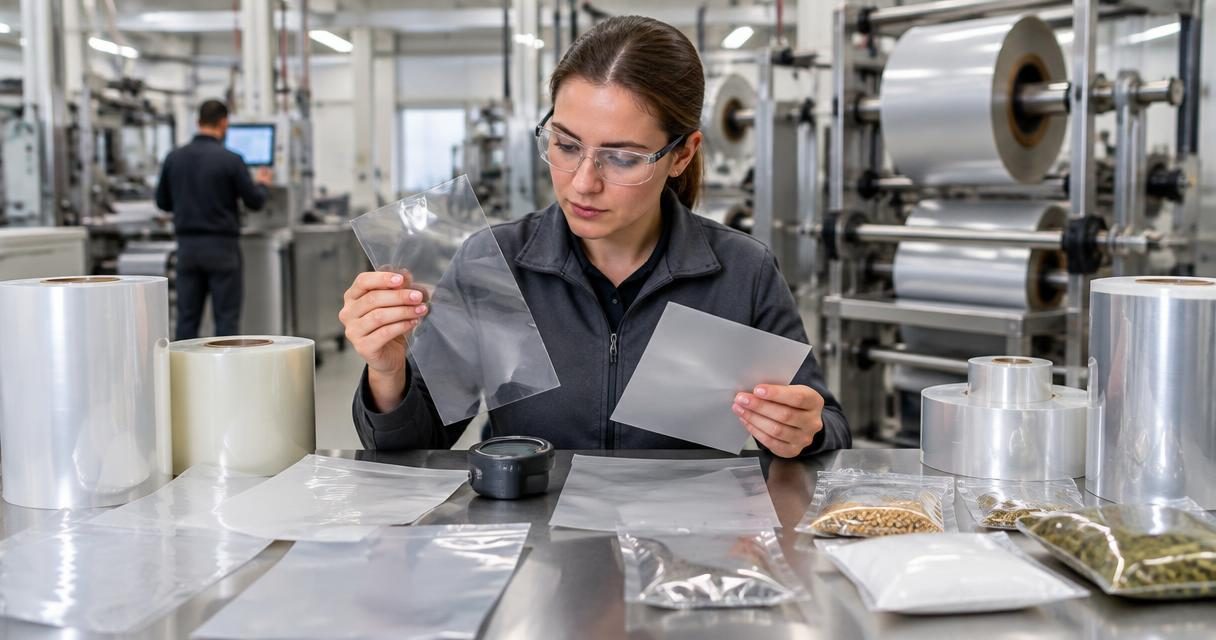
Choose flexible packaging film by working backward from product failure. If crackers lose crispness, moisture control matters. If an oily powder develops off-flavors, oxygen exposure may be critical. If frozen pieces puncture a pouch during handling, a strong barrier specification alone will not solve the problem.
The goal is not the highest barrier or thickest film available. It is a structure that protects the product, seals reliably, runs on the intended equipment, and survives its distribution route without unnecessary material or complexity. Use the following framework to turn those needs into a purchasing specification and a practical test plan.
1. Define Product Risks Before Selecting Materials
Start with a short product profile shared by purchasing, operations, quality, and product development. Record the product’s physical form, composition, fill weight, storage conditions, and intended shelf life. Include what happens after opening if the package must support repeated use.
Then rank likely failure modes. A dry snack may absorb moisture, lose aroma, or become rancid. A sauce may require protection against leakage and a structure compatible with its formulation and filling process. Sharp pet treats may create localized puncture stress.
Build the profile around these questions:
- What makes the product unacceptable: flavor change, texture loss, discoloration, leakage, or something else?
- Is it sensitive to oxygen, moisture gain, moisture loss, or light?
- Does it contain oils, acids, aromas, or other components that could interact with packaging?
- Will filling involve heat, refrigeration, freezing, or a validated treatment process?
- What unopened shelf life is required, under which storage conditions?
Treat these answers as requirements to investigate, not proof that a particular polymer will work. Food-contact suitability must also be confirmed for the specific product, contact conditions, and destination market.
2. Match Each Barrier to a Specific Failure Mode
“High barrier” is incomplete language for a purchase specification. Identify what must be restricted, then request relevant measurements with their test conditions.
Oxygen and moisture
Oxygen transmission rate, or OTR, helps compare resistance to oxygen passing through a material. Water vapor transmission rate, or WVTR, addresses moisture movement. Lower values generally indicate greater resistance under the stated test conditions, but results measured at different temperatures or humidity levels may not be directly comparable.
For crisp products, moisture entering the package can be the limiting factor. For products that dry out, moisture leaving may matter instead. Oxygen-sensitive foods may need both suitable film performance and control of oxygen already present at filling.
Do not convert a film data sheet directly into a shelf-life promise. Package area, seals, closures, headspace, product behavior, and storage conditions all affect the result.
Light and grease
Light protection is a separate requirement. Clear films can provide useful oxygen or moisture resistance without adequately protecting a light-sensitive product. Ask whether pigmentation, printing, metallization, or foil is needed, and evaluate any viewing window as part of the design.
Grease resistance also deserves its own review. Oily contents can challenge material compatibility and contaminate seal areas. An oxygen-barrier claim does not establish grease resistance or reliable sealing through oil.
Decision check: Request comparable barrier data, identify the acceptable product endpoint, and document whether light exposure and grease contact need additional testing. Barrier layers such as EVOH, metallized films, or foil are candidates to evaluate—not interchangeable solutions.
3. Choose the Sealant Around the Filling Process
The sealant is the product-facing layer responsible for forming the package’s heat seal. Its selection affects leak resistance, operating flexibility, and consumer opening behavior.
Polyethylene- and polypropylene-based sealants are common starting points, but broad material names do not define performance. Grade, formulation, layer thickness, and the complete structure matter. Hot filling, freezing, or thermal processing can introduce additional requirements that must be evaluated specifically.
Give the film supplier an accurate picture of the seal area. Will it encounter powder, oil, moisture, or trapped product? How much time is available for sealing? Does the seal need to withstand loading before it fully cools?
A useful checklist includes:
- Seal initiation behavior and the usable sealing window.
- Hot tack, meaning seal strength while the seal is still hot.
- Seal strength after cooling and conditioning.
- Leak resistance under expected contamination conditions.
- Compatibility with required easy-open or peelable features.
For example, a fine seasoning powder can produce occasional dust contamination at the seal. Test realistic contamination levels and improve filling controls rather than assuming a different sealant will compensate for poor seal-area management. Seal strength and package integrity should both be assessed; neither alone tells the whole story.
4. Balance Stiffness and Puncture Resistance
Film thickness is not a complete measure of package durability. Two structures with similar total thickness can behave differently because of their constituent materials, orientation, and layer arrangement.
Stiffness influences how a pouch stands, how it feels in the hand, and how it moves through handling equipment. Too little stiffness can make presentation or loading difficult. Too much can complicate folding, opening, or package formation.
Puncture resistance addresses concentrated forces from sharp contents or handling hazards. Tear behavior, abrasion resistance, and resistance to repeated flexing are additional considerations. Flexing can damage some barrier layers even when the package initially looks intact.
Consider a pouch of irregular dried treats. A thicker structure may help, but changing pouch dimensions, reducing tight contact at corners, or improving the shipping case may address the problem more effectively.
Decision check: Evaluate filled packages, not just flat film samples. Look for punctures, abrasion, stress near seals, and barrier changes after handling. Keep appearance requirements separate from protection requirements so a premium feel does not become a substitute for evidence.
5. Check Equipment Compatibility Early
A technically suitable film can still cause operational problems if its behavior does not match the packaging line. Confirm whether the purchase is roll stock or premade pouches, then identify the equipment and package features involved.
For roll stock, relevant details may include web width, unwind direction, core and roll dimensions, registration requirements, and the film’s friction characteristics. For premade pouches, confirm dimensional tolerances, opening behavior, seal-area access, and compatibility with the intended filling and closing equipment.
Quantum Flex Pack’s guide to custom stand-up pouches and roll stock can help frame the format discussion before detailed specifications are developed.
Run a controlled trial using production-representative material and product. Record line conditions, stops, scrap, seal appearance, and integrity results. Do not judge compatibility solely by whether the line reaches a target speed briefly.
Final settings require equipment-specific validation. Sealing temperature, pressure, and dwell time interact; copying settings from another film or machine is not a reliable qualification method.
6. Design for the Actual Distribution Route
Describe the journey after packing: storage, palletization, transportation, order fulfillment, retail display, and consumer handling. Include plausible temperature and humidity excursions rather than only ideal warehouse conditions.
A refrigerated product shipped in a controlled case and a pouch mailed individually through a parcel network face different stresses. Secondary packaging can change the protection required from the film itself.
For frozen foods, assess the structure at the temperatures it will actually encounter. Some materials become less tolerant of impact or flexing when cold. Product edges, ice formation, and handling conditions can also affect package damage. The frozen food packaging guide provides related considerations for defining that application.
Build a distribution checklist:
- Expected storage duration and temperature range.
- Humidity exposure and condensation scenarios.
- Drop, vibration, compression, and abrasion hazards.
- Case configuration and pallet support.
- Altitude or pressure changes where relevant.
Test the filled package together with its intended shipping configuration. After transport simulation or a monitored shipment trial, inspect seals and surfaces, check integrity, and reassess product quality as needed.
7. Evaluate Sustainability Without Losing Protection
Sustainability choices should be tied to a clear objective. Reducing material weight, designing for a particular recycling stream, incorporating suitable recycled content, and reducing product loss are different goals. They may support one another, but they can also create trade-offs.
A lighter film may reduce packaging material while leaving less margin against puncture. A predominantly single-polymer design may simplify material compatibility for certain recycling systems, yet still need evaluation for barrier, heat resistance, and sealing performance. Recycled content introduces questions about consistency, suitability for product contact, and applicable requirements.
Do not assume that a mono-material label means a package will be collected or recycled wherever it is sold. Closures, coatings, inks, adhesives, local collection access, and sorting practices can affect the outcome. Environmental claims should be specific and supported for the intended market.
Use the Quantum Flex Pack sustainability page as a starting point for questions, not as proof that a particular structure meets your project’s targets.
Compare candidate structures against the same functional requirements. A sustainability improvement should survive production, distribution, and shelf-life testing rather than depend on accepting preventable product damage.
8. Validate the Complete Package and Shelf Life
Qualification should connect material data to actual package performance. A useful sequence moves from screening to line trials, distribution evaluation, and shelf-life testing, with feedback between stages.
Screen and trial candidate structures
Review technical data and applicable product-contact documentation. Check dimensions, construction, barrier measurements, and seal performance against the written requirements. Where laminations are involved, confirm any required conditioning or cure period before conversion, filling, or testing.
Next, fill representative packages on the intended equipment. Include realistic operating variation and a documented sampling plan. Evaluate more than attractive startup samples: sustained running and normal interruptions can reveal different problems.
Define shelf-life acceptance criteria
Establish what constitutes failure before testing begins. Depending on the product, measures may include sensory quality, texture, moisture, oxidation indicators, appearance, microbiological criteria, or package integrity. Select methods with qualified quality or food-safety personnel as appropriate.
Use storage conditions that reflect the intended market. Accelerated studies may support development when the relationship to actual storage is justified, but they do not automatically replace real-time testing.
For example, a nut mix could retain an intact seal yet develop unacceptable flavor. That result calls for evaluating oxygen exposure and product oxidation, not simply increasing seal strength.
Final structures and operating settings require validation with the actual product, equipment, distribution conditions, and shelf-life target. Reassess relevant risks when formulation, package size, film construction, or logistics change.
9. Turn the Findings Into a Purchase Brief
Give suppliers a shared brief so proposals can be compared on equivalent terms. Include the product profile, package dimensions, fill conditions, barrier priorities, closure features, equipment details, shipping route, shelf-life objective, and required documentation.
The stand-up pouch manufacturing specifications guide is a useful reference for organizing pouch-specific details. Separate firm requirements from preferences and unresolved questions.
Ask each proposal to identify the recommended construction, assumptions, supporting data, and validation work still needed. Compare total operational consequences—not only material thickness or unit price. Scrap, filling interruptions, damage, and obsolete inventory can change the purchasing decision.
Bring that brief, along with available product samples and trial results, to discuss your packaging project with Quantum Flex Pack. A clear account of what the package must protect against is the best starting point for evaluating the right flexible packaging film.