
Most flexible packaging projects come down to one decision made early and rarely revisited: pre-made pouches, or roll stock? Everything downstream — film structure, printing method, tooling, cost per unit, even how many people you need on a filling shift — follows from it.
The choice is not about which format is better. It is about how you fill, how much you sell, and how often your artwork changes.
Custom stand up pouches
A stand up pouch arrives finished. It has been printed, laminated, formed, gusseted, sealed on three sides and fitted with any zipper or spout, and it is ready to fill and seal.
That matters most for brands without automated filling equipment. You can fill a stand up pouch by hand or with a simple tabletop sealer, which is why the format dominates for early-stage food, supplement, pet and specialty brands, and for anyone using a co-packer who works with pre-made bags.
The format also sells well. A pouch that stands upright with a flat face gives designers a billboard in the planogram, and the bottom gusset — either a doypack or a K-seal — determines how squarely it stands when partially empty. Flat-bottom and quad-seal variants stand more rigidly and use shelf cube more efficiently for larger fills, at somewhat higher tooling and unit cost.
Common features worth deciding up front:
Press-to-close zippers for multi-serve products. Tear notches so the pack opens cleanly without scissors. Round or euro hang holes for peg display. Degassing valves for fresh-roasted coffee. Spouts and fitments for liquids, gels and purees. Clear windows where showing the product helps the sale.
Each of these affects tooling and converting, so raising them at quote time is cheaper than adding them later.
Roll stock
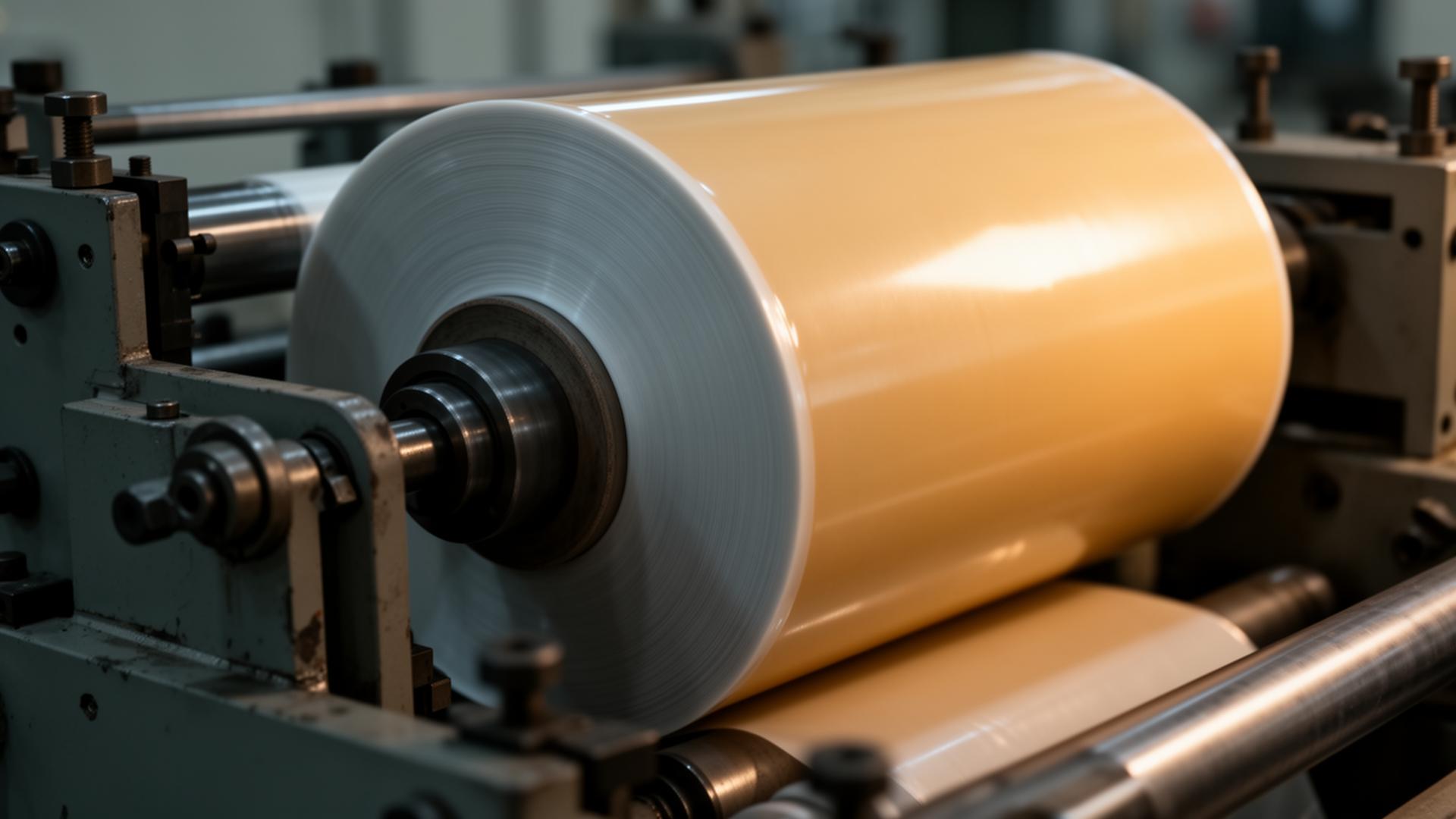
Roll stock is printed, laminated film wound on a roll. Your form-fill-seal machine forms the pouch, fills it and seals it in one continuous motion.
Per-unit cost is lower, because you are not paying anyone to convert the film into a finished bag. Storage is far more efficient: a roll takes a fraction of the space of the equivalent count of pre-made pouches. And a well-tuned VFFS line will outrun hand filling by an order of magnitude.
The requirement is equipment and precision. The film has to match your machine: web width, core size, roll diameter, unwind direction, film stiffness, seal jaw temperature window and eye-mark registration all need to be right. A supplier who does not ask about your machine before quoting roll stock is a supplier to be careful with.
Brands frequently run both. Pre-made pouches for low-volume, high-variety SKUs and retail-facing items; roll stock for the two or three products that carry the volume.
Choosing between them
Fill method decides most cases. No filling equipment, or a co-packer running pre-made bags, means stand up pouches. An in-house VFFS or HFFS line means roll stock.
Volume decides the rest. Below roughly a few thousand units per SKU per run, the converting cost of finished pouches is easy to absorb and equipment cannot be justified. Once a single SKU runs consistently in the tens of thousands, the case for automated filling and roll stock gets strong.
Shelf presence tips ambiguous cases toward pouches. A pillow bag formed on a VFFS line is cheaper, but a stand up pouch holds a face to the shopper.
Film structure: the decision underneath both
Format determines how the package is made. Structure determines whether the product inside survives.
Two-layer PET/PE laminates cover products with moderate barrier needs — dry goods, pasta, treats, bath products. Metallized PET/VMPET/PE adds serious oxygen and light barrier for coffee, nuts, snacks and supplements, where oxidation is what ends shelf life. Foil laminations sit at the top of the barrier range for the most sensitive products. Nylon-containing structures add puncture and flex-crack resistance for sharp or heavy contents. Kraft paper laminates give a natural look with a functional barrier bonded behind it.
Recyclable mono-material PE films and PCR-content structures are available in both formats. They seal in a narrower window than conventional laminates, so plan a trial run rather than converting a top SKU on the first order.
Get honest about shelf life before choosing. A structure specified for six months will not quietly deliver eighteen.
Digital printing or rotogravure
Rotogravure prints from engraved cylinders — one per color. Quality at very long runs is excellent and per-unit cost is unbeatable once the volume is there, but every design and every revision carries cylinder cost and weeks of lead time.
Digital printing has no plates or cylinders. Setup is a file, so multiple SKUs, variable text, seasonal versions and retailer-specific packs cost effectively the same per unit as a single design, and revisions are a new file rather than new tooling. That is why brands with a growing SKU count and evolving artwork have moved toward digital, and why our NextGen printing capabilities sits at the center of how we produce any sized runs.
The decision rule is straightforward. One design, locked artwork, very high sustained volume: rotogravure earns its tooling back. Multiple SKUs, changing artwork, uncertain forecasts, or a need to be in market quickly: digital wins on total cost even when the per-unit number is slightly higher.
Getting the artwork right
Whatever format and press you choose, prepress discipline saves the most time. Build to the supplied dieline. Keep critical copy and logos out of the seal areas and gusset fold. Set up in CMYK with Pantone references called out for brand colors. Provide bleed. Remember that on a stand up pouch the bottom gusset wraps and part of that artwork disappears when the pouch is standing.
Ask for a physical proof, not just a PDF, when color is critical. A screen will not tell you how a matte lamination changes a saturated color.
Where to start
If you know your product, fill weight, fill method and expected volume per SKU, a supplier can recommend a format and structure in one conversation. If you are still deciding, the sequence is: confirm fill method, set required shelf life, choose format, then choose structure and print method.
Send those details through our quote request and we will come back with a recommended structure, format and realistic lead time for your project.